Wasted spend and audits
How to improve ROAS in Google Ads
Reviewed September 2026 · All guides
To improve ROAS in Google Ads, make sure every conversion sends the right value, bid on that value with Maximize conversion value or Target ROAS, split products or services with different margins into campaigns or asset groups with their own targets, and raise Target ROAS in steps of roughly 10-15%. Where the business cares about new customers or profit more than revenue, send values that say so. Bidding can only optimise the number you give it, so a wrong value makes every other lever point in the wrong direction.
This guide takes those levers in order and ends with how to test each one, because a ROAS gain that also halves revenue is rarely what the business wanted.
1. Make conversion values accurate
ROAS is conversion value divided by cost, so the value side has to be right before anything else. Check Goals > Conversions for:
- Purchase actions sending a fixed value (often 1) instead of the transaction value.
- Value including tax and shipping in one market and excluding it in another, which makes campaigns look different when they are not.
- Currency mismatches: an order in GBP reported as the same number in EUR.
- Lead actions with no value, or the same value for a qualified lead and a spam form. Assign values per stage, and import offline conversions from the CRM with the value of the closed deal where you can.
- Two actions counting the same purchase, both Primary, which doubles the value and the reported ROAS.
Compare 30 days of Google Ads conversion value with revenue in your backend for the same dates and the same attribution. The conversion tracking checklist covers Enhanced conversions, Consent Mode v2 and the other checks that decide how much value gets recorded at all.
Profit or revenue
Revenue ROAS treats a EUR 100 sale at 60% margin and a EUR 100 sale at 10% margin as equal. If margins differ a lot across the catalogue, the bidder will favour whatever sells, including the low-margin products. Two ways to fix it: send gross profit, or a margin-weighted value, as the conversion value from your tag or server; or keep revenue as the value and set separate Target ROAS figures per margin tier (section 3). Conversions with cart data plus the cost_of_goods_sold attribute in Merchant Center let Google Ads report gross profit alongside revenue, which is a useful check even if you keep bidding on revenue. On top of that, Google has a gross profit optimization setting in beta for Performance Max and Standard Shopping that bids on that profit; check whether your account has it. If you switch to profit values, every historical ROAS figure changes meaning, so reset the targets from the new baseline rather than carrying the old number over.
2. Bid on conversion value
Maximize conversions and Target CPA optimise the number of conversions. Maximize conversion value and Target ROAS optimise their value, so the bidder pays more for an auction likely to produce a EUR 900 order than one likely to produce a EUR 20 order. If order values vary by a factor of three or more, value-based bidding tends to fit better. The comparison of Target CPA, Target ROAS and Maximize conversions goes through when each one fits.
A common path: switch to Maximize conversion value without a target, let it run two to three conversion cycles, then add a Target ROAS at about the ROAS it achieved. Setting a target far above the current ROAS on day one restricts the auctions the campaign can enter before it has learned anything. As a rule of thumb, value-based bidding wants a steady flow of conversions with values, in the range of 30-50 a month per strategy, to predict well.
Conversion value rules (Goals > Conversions > Value rules) let you raise or lower value by location, device or audience, for example valuing a returning customer in a high-lifetime-value region higher. Use them for differences you can measure in your own data, since the bidder will follow them.
3. Segment products and campaigns by margin and performance
One Performance Max or Shopping campaign with one Target ROAS for the whole catalogue has to pick a single number for products whose economics differ. Splitting lets each group bid to its own target:
- Add custom labels in the Merchant Center feed (custom_label_0 to custom_label_4): margin tier, price band, bestseller versus long tail, seasonal.
- Build listing groups or separate campaigns on those labels. A common split is high-margin products at a lower Target ROAS, since each sale earns more, and low-margin products at a higher one.
- Pull products that spend without selling for 60-90 days into their own group with a tight target or a small budget, so they stop drawing from the main one.
- Keep each resulting campaign above the conversion volume the bidder needs. Splitting into ten thin campaigns trades one problem for another.
For Search and lead-gen, the same logic applies to services: a service with twice the value per conversion belongs in a campaign where a different target is possible. Feed quality matters too: accurate titles with the terms people search, correct prices and availability, and good images raise click-through rate on the queries that sell.
4. Raise Target ROAS in steps
A higher Target ROAS makes Smart Bidding skip auctions with lower predicted value per euro. ROAS goes up and conversion value usually goes down. Say a campaign spends EUR 40,000 a month at 400% ROAS, EUR 160,000 of conversion value. Raising the target to 500% in one move might give 470% ROAS on EUR 25,000 of spend: EUR 117,500 of value, EUR 42,500 less than before. Whether that is better depends on margin, and on whether the EUR 15,000 saved has a better use.
- Decide the metric the business is measured on: ROAS, conversion value, or profit after ad spend. Write it down before changing anything.
- Raise Target ROAS by roughly 10-15% per step, a rule of thumb that keeps the change inside what the bidder adapts to without a long learning period.
- Wait for the bid strategy status to leave 'Learning' and at least one conversion cycle to pass, often one to two weeks.
- Compare ROAS and total conversion value against the period before. Stop raising the target when the value lost outweighs the efficiency gained.
The guide to changing Target ROAS covers step sizes, seasonality adjustments and what to do when a campaign stalls after a change.
5. Value new customers explicitly
If a first order is worth more to the business than a repeat one, because of lifetime value, tell the bidder. The new customer acquisition goal, available on Performance Max, Search, Shopping and Demand Gen, has two modes: bid higher for new customers by adding a fixed extra value to a new-customer conversion (Maximize conversion value or Target ROAS only), or bid for new customers only. It identifies existing customers from customer lists you upload, the new-customer parameter in your conversion tag, and Google's own detection from past purchases, so an up-to-date customer list matters. A separate retention goal does the reverse and bids more for lapsed customers.
Adding new-customer value raises reported conversion value, and so reported ROAS, without a single extra euro of revenue. Report ROAS on actual revenue alongside it, or the gain will look larger than it is.
6. Test changes instead of switching them
Bid strategy changes, target changes and value rule changes are all testable. A custom experiment on a Search campaign splits traffic between the original and a trial with the new strategy or target, and reports the difference in conversion value and ROAS with a confidence level. Performance Max supports its own experiment types, covered in how to test Performance Max. Run each test for at least two conversion cycles, and read conversion value alongside ROAS, as covered in how to read experiment results.
Where GoodLads fits
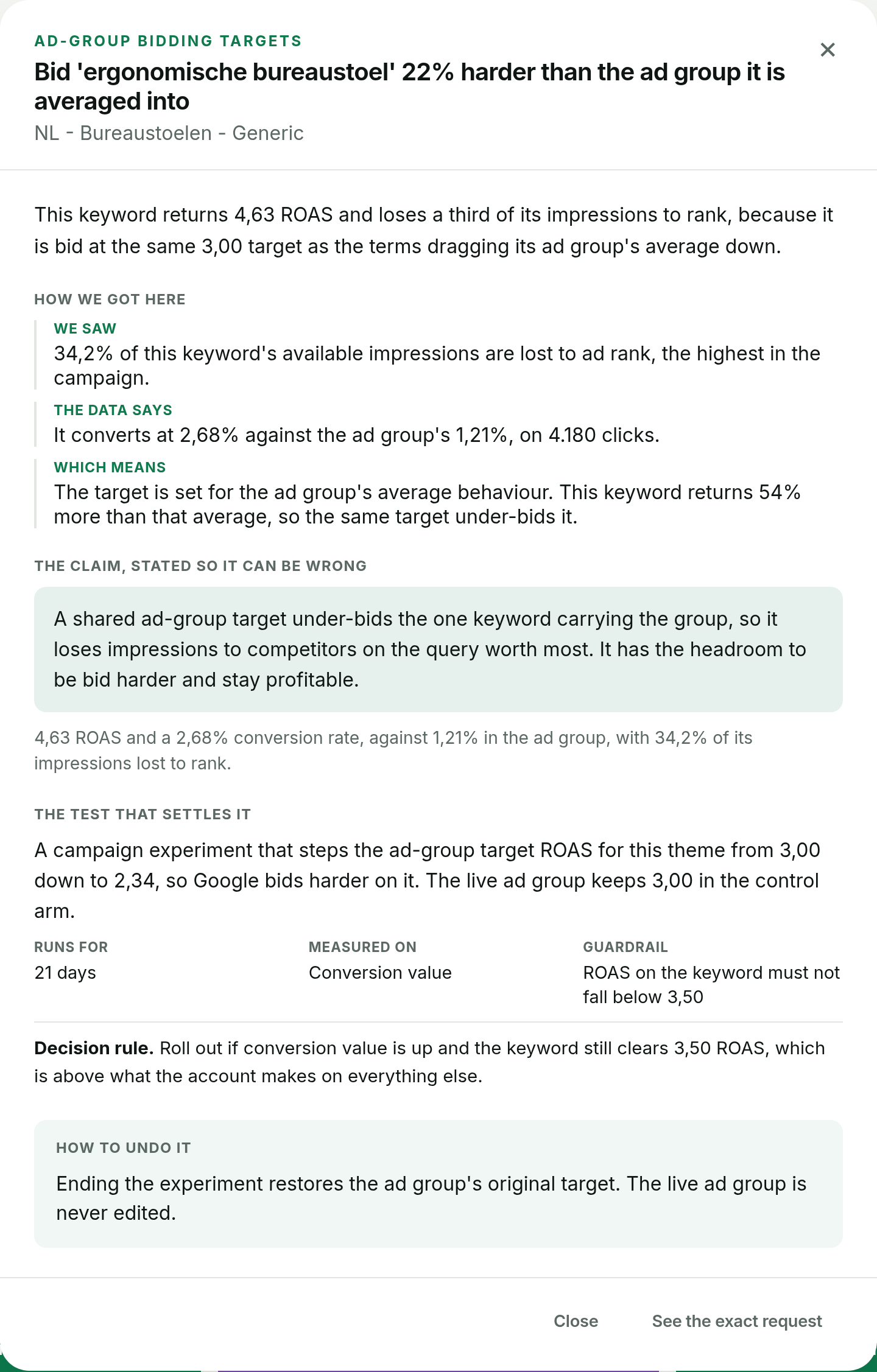
GoodLads writes three recommendations per campaign aimed at ROAS or CPA, grounded in the account's last 30 days and research on the company behind it. A target change is proposed as a step from the current figure and applied as a Google Ads experiment where the campaign can run one. Each applied recommendation is tracked on a board until there is a verdict. The free audit flags campaigns that spend without recording any conversion value, which is often the first ROAS problem to fix.
It does not edit your Merchant Center feed, set up conversion value rules or import CRM values for you. See a sample on the demo, or query your account's data from Claude or ChatGPT through the MCP endpoint.
Questions people ask
How do I improve ROAS in Google Ads?
Check that conversion values match your backend revenue, bid on value with Maximize conversion value or Target ROAS, segment products with different margins into their own targets, and raise Target ROAS in steps of roughly 10-15%.
Why did my revenue drop when I raised Target ROAS?
A higher Target ROAS makes Smart Bidding skip auctions with lower predicted return, so it spends less and wins fewer conversions. ROAS rises while total conversion value falls.
Should I bid on profit or revenue in Google Ads?
Bid on profit, or set separate targets per margin tier, when margins vary widely across products. Revenue works when margins are similar, because a single Target ROAS then maps to a single profit level.
What is a good ROAS for Google Ads?
One above your break-even ROAS, which is 1 divided by your gross margin. At a 40% margin, break-even is 250%, and anything below it loses money on the first order.