Bidding and budgets
Target CPA vs Target ROAS vs Maximize conversions
Reviewed September 2026 · All guides
Use Target ROAS when your conversions are worth different amounts and you pass those values to Google Ads, such as ecommerce baskets or leads scored by deal size. Use Target CPA when every conversion is worth roughly the same and you know what one may cost. (From 2021 until June 2026 Search showed these two as Maximize conversion value and Maximize conversions with an optional target; Google has since restored the standalone names, and the bidding did not change.) Use Maximize conversions or Maximize conversion value without a target when the budget is the limit you care about and you want Google to spend it in full, or while a campaign builds the conversion history a target needs.
The decision sits on two questions: do conversion values vary enough to matter, and does the campaign get enough conversions for Google to bid against a target? The rest of this guide goes through how each strategy bids, where each one fails, and how to move between them without a month of wasted spend.
How each strategy decides a bid
All four strategies are Smart Bidding: Google sets a bid per auction using signals you cannot bid on manually, such as device, location, time, browser, audience membership and the query itself. What differs is the goal the bid is solved against.
Maximize conversions
Bids for the largest number of conversions the daily budget can buy. It has no cost ceiling. If the budget is EUR 1,000 a day, the strategy will try to spend EUR 1,000 a day, and the marginal conversions near the end of that budget are the most expensive ones you buy.
Target CPA
Adds an average cost per conversion the strategy aims for. Google will pay more than the target in some auctions and less in others, so individual conversions land either side of it. With a target set, the campaign may spend less than its budget when there are not enough auctions at that cost. From 2021 until June 2026 a Search campaign showed it as an optional target under Maximize conversions; since June 2026 Google lists it as Target CPA again, with the same bidding behind it.
Maximize conversion value
The value-based counterpart of Maximize conversions: bids for the most total conversion value the budget can buy, again with no efficiency ceiling.
Target ROAS
Adds a return target, entered as a percentage: 400% means EUR 4 of conversion value for every EUR 1 of spend. The strategy will bid up for auctions it predicts carry high value and down, or out, for low-value ones. A high target narrows the auctions it enters, so volume and spend fall as the target rises.
Which one to use
Start from the business, then check the data can carry it.
- Conversion values vary by more than about 2x between typical conversions, and the value reaches Google Ads on each conversion: Target ROAS. A shop where one order is EUR 40 and another EUR 400 wants the bidder to know the difference.
- Every conversion is worth about the same, such as a demo request, a free trial or a booked call: Target CPA. Feeding it made-up values only adds noise.
- Values vary, but you do not pass them, or they arrive days later from a CRM: fix the values first. Until then, Target CPA on the primary conversion is the honest choice. The conversion tracking checklist covers offline imports and Enhanced conversions.
- Fewer than about 30 conversions a month in the campaign: Maximize conversions without a target, a portfolio across several campaigns, or a higher-volume conversion action as the primary goal.
- A fixed budget that must be spent in full, such as a launch or a quarter-end push: Maximize conversions or Maximize conversion value without a target, with a close eye on cost per conversion.
Say an ecommerce campaign spends EUR 30,000 a month and returns EUR 120,000 in tracked revenue, a 400% ROAS, from about 900 orders. Order values run from EUR 35 to EUR 600. Target CPA at EUR 33 would pay the same for a EUR 35 order as for a EUR 600 one. Target ROAS at 400% bids more for the queries that tend to bring large baskets, which is where the return is.
A B2B campaign spending EUR 20,000 a month for 250 demo requests at EUR 80 each is the opposite case. If sales cannot say which demo is worth more at the time it happens, the values would be guesses, and Target CPA at EUR 80 does the job.
The four strategies side by side
- Maximize conversions: goal is conversion count; spends the full budget; no cost control beyond the budget; works on low volume; best for fixed budgets and building history.
- Target CPA: goal is conversion count at an average cost; may underspend the budget; control is the CPA target; wants roughly 30 to 50 conversions a month; best for equal-value leads and sign-ups.
- Maximize conversion value: goal is total value; spends the full budget; no efficiency control; needs values on conversions; best for fixed budgets with varied order values.
- Target ROAS: goal is value at a return; may underspend the budget; control is the ROAS target; wants steady conversion volume and reliable values; best for ecommerce and value-scored leads.
Both target-based strategies accept a target that is far from history, and both respond by pulling volume. A Target CPA set at half the current cost per conversion does not halve the cost. It shrinks the auctions the campaign enters until spend drops, often by more than the CPA improves.
Switching between strategies
Changing the bid strategy puts the campaign into a learning period, shown as the bid strategy status 'Learning'. Google's help says calibration typically takes one to two conversion cycles and suggests allowing about 50 conversions before judging; in practice that is at least a week, and longer for campaigns with few conversions or a long conversion lag. Performance during that week is noisier and often worse, so plan the change for a week that is not your biggest.
Set the first target from what the campaign already does. When moving from Maximize conversions to a Target CPA, use the average CPA of the last 30 days, not the CPA you wish you had. When moving from Target CPA to Target ROAS, use the realized ROAS of the same period. Tighten it later, in steps, as described in how to change a Target ROAS or Target CPA.
- Check the conversion data first: the primary conversion actions are the ones you want to bid on, values arrive on each conversion, and nothing broke in the last 30 days.
- Read the realized CPA or ROAS over the last 30 days, excluding days with tracking problems.
- For a campaign that carries real spend, create a custom experiment under Campaigns > Experiments with the new strategy in the treatment arm and a 50% split.
- Leave both arms alone for at least two full conversion cycles after the learning period ends.
- Apply the treatment only if it wins on the metric the business is measured on, not on the metric the new strategy optimizes.
An experiment is the higher-cost option in time, and it is the only way to know whether the switch caused the change. A before-and-after read mixes the strategy with seasonality, competitors and whatever else moved that month. How to run a Google Ads experiment walks through the setup.
Portfolio bid strategies
A portfolio strategy, created under Tools > Budgets and bidding > Bid strategies, applies one target across several campaigns and pools their conversion data. Two campaigns with 20 conversions a month each struggle to hold a target on their own; together they have 40.
What you gain in data you give up in control. The strategy balances the target across the portfolio, so one campaign can run well above the target while another runs below, and the average still reads as on target. Group campaigns only when they share a goal and a value per conversion: brand and non-brand in one portfolio lets cheap brand conversions subsidize expensive generic ones.
Portfolio Target CPA and Target ROAS strategies also allow maximum and minimum CPC bid limits, used in Search Network auctions only; the standard campaign-level versions do not. Google advises against them because they restrict the bidder. Use it as a guard against runaway bids on thin data, and remove it once the portfolio has volume, since a cap limits the auctions the strategy can win.
Where GoodLads fits
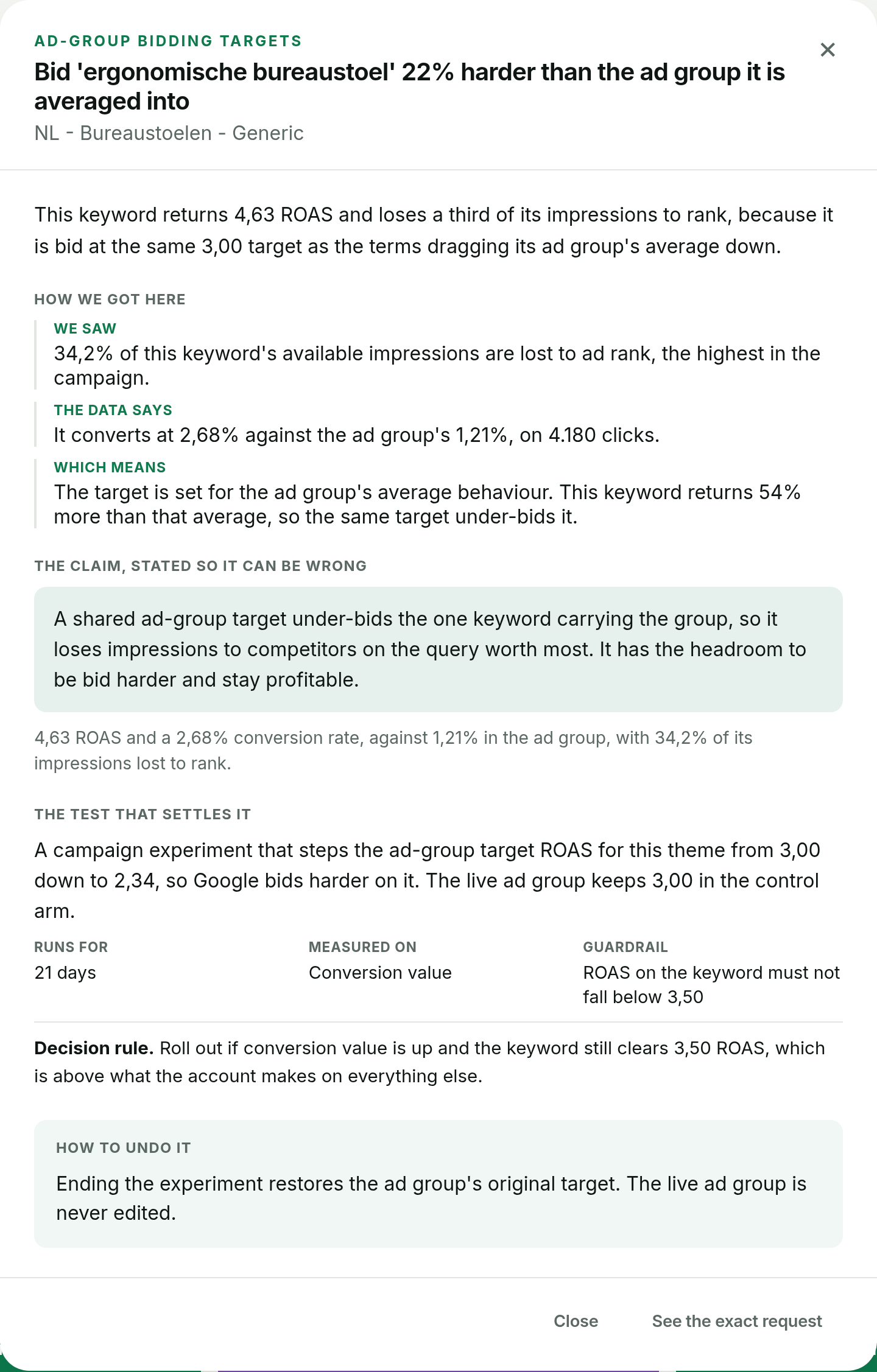
GoodLads reads each campaign's bid strategy, its target and the realized CPA or ROAS, and proposes changes against them. On Search campaigns a target change arrives as a Google Ads experiment with a conservative step, applied on your click, and tracked on a board until there is a verdict. It does not re-tune bids across every campaign on a schedule; if you want rules that adjust targets automatically, see Optmyzr or Google Ads scripts.
The free audit on a connected account shows what it is doing and the three changes worth making first. To see the output before connecting anything, open the worked demo account.
Questions people ask
Should I use Target CPA or Target ROAS?
Use Target ROAS when conversions are worth different amounts and you pass those values to Google Ads. Use Target CPA when conversions are worth about the same, or when you have no reliable value per conversion.
Is Maximize conversions better than Target CPA?
Maximize conversions spends the full daily budget and has no cost ceiling, so it suits a fixed budget or a campaign still building history. Target CPA adds an average cost limit and may spend less than the budget to hold it.
How many conversions do you need for Target ROAS?
Google no longer publishes a hard minimum. As a rule of thumb, a campaign or portfolio with 30 to 50 conversions a month holds a target far better than one with 10.
Does changing bid strategy reset learning?
Yes. A new strategy puts the campaign into the 'Learning' status, which Google says typically lasts one to two conversion cycles, longer with low volume or long conversion lag. Test the switch in a custom experiment if the campaign carries meaningful spend.