Comparison
GoodLads vs Adalysis
Reviewed June 2026 · All comparisons
Adalysis and GoodLads share an important belief: that the right way to improve an account is to test, not to tinker with live ads on a hunch. Adalysis built its reputation on rigorous, statistically aware ad testing and deep automated audits. GoodLads built its ladder on the same instinct, expressed differently.
Adalysis is a practitioner-grade tool created by a well-known paid-search authority. This page sets out where it leads, where it asks for trade-offs, and where GoodLads is and is not the stronger choice.
At a glance
| How they compare | GoodLads | Adalysis |
|---|---|---|
| Primary focus | Three AI recommendations per campaign, plus safe one-click apply | Automated account audits and scientific ad (RSA) testing |
| Channels | Google Ads only | Google and Microsoft Ads |
| How changes are applied | A new paused ad or a Google Ads experiment first; live only for the few levers with no test form | Surfaces fixes for one-click apply; can automatically pause and replace losing ads |
| Ad testing | Recommends new ads and Google Ads experiments as the path to a fair test | Continuous statistical RSA testing that flags significant winners and losers |
| Audits | Not an audit tool; focuses on a few forward-looking moves | 40 to 100+ automated daily checks across the whole account |
| Business context | Researches the company behind the account to ground its copy | Metric-driven and rules-driven; no company-research layer |
| Interface | Polished and premium | Functional, but reviewers describe it as dated |
| Pricing model | $100 per month, flat, whatever the account spends | Spend-tiered from $149 per month, oriented to $50K+ monthly spend, with unlimited accounts and users |
What Adalysis is built for
Adalysis was founded in 2013 by Brad Geddes, a recognized authority in paid search and the author of a well-known book on Google advertising. The product reflects that pedigree: it is a focused, analytical tool for Google and Microsoft Ads, built around two pillars.
The first is auditing. Adalysis runs dozens to over a hundred automated checks every day, catching the kinds of issues that quietly waste spend: duplicate keywords, keyword conflicts, ad groups with no active ads, low Quality Score clusters, budget pacing problems and negative-keyword gaps. The second is ad testing. Its engine continuously monitors responsive search ad performance, identifies statistically significant winners and losers, and recommends which headlines and descriptions to keep, pause or replace. For an account where ad testing matters, this rigor is the main reason people choose it.
It also handles budget pacing and forecasting, keyword management, campaign building and white-label reporting. Pricing is transparent and includes unlimited accounts and users, which makes it attractive to agencies running many client accounts.
How GoodLads approaches the same job
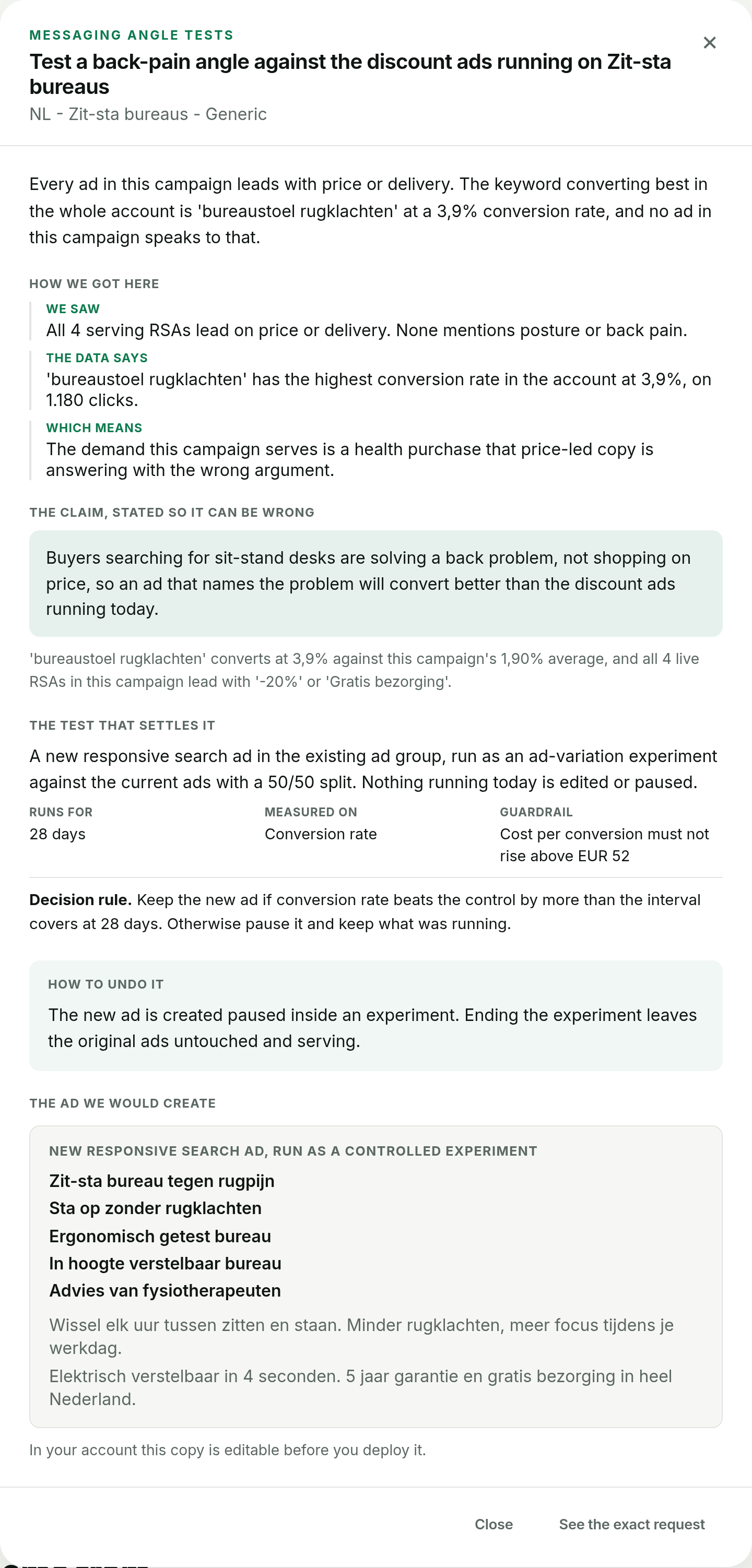
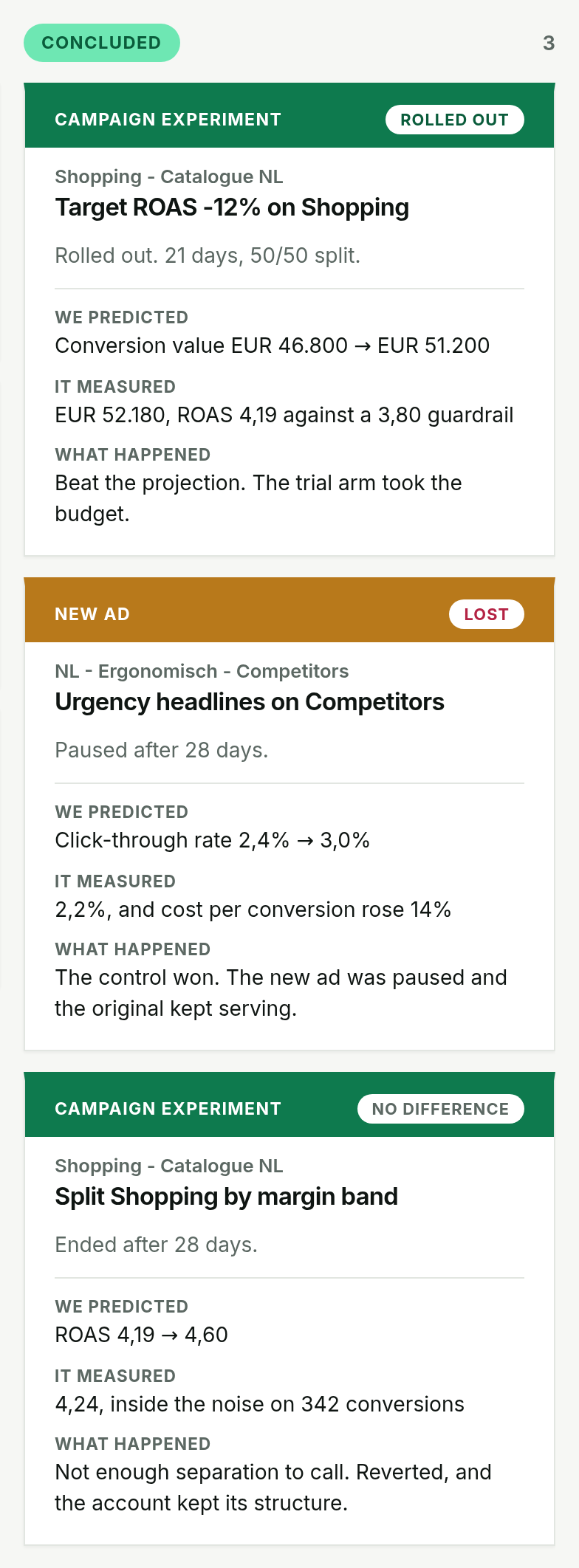
GoodLads and Adalysis both prefer creating and testing over editing in place. Adalysis builds new responsive search ads to run an A/B test rather than rewriting an existing one, which is philosophically close to the way GoodLads defaults to a new paused ad or a Google Ads experiment rather than editing what's already running.
The differences are in emphasis and intelligence. Adalysis is primarily an analyst's toolkit: it surfaces problems and significant results with great rigor, and leaves most of the strategic decisions to you. GoodLads is more opinionated and more generative. It does not audit everything; it reads your account, researches the business behind it, and proposes three moves with the ad copy already written, framed in terms of return on ad spend.
There is also a meaningful difference in automation. Adalysis can automatically pause and replace losing ads on your behalf. GoodLads will never make a spend-affecting change without your explicit, one-click approval, and it never pauses or edits a live ad automatically. Whether that is a strength depends entirely on how much you want a tool to act on its own.
Where Adalysis is strong
For testing-minded advertisers and agencies, Adalysis is a strong tool, and in ad testing specifically it is more rigorous than GoodLads.
- Best-in-class statistical ad testing, with clear identification of significant winners and losers.
- Comprehensive automated audits that catch issues a human would miss across many accounts.
- Solid budget pacing, forecasting and overspend alerting, valuable for agencies managing dozens of accounts.
- Coverage of both Google and Microsoft Ads, with unlimited accounts and users on a transparent plan.
- A focused product from a credible founder, rather than a thin layer spread across many channels.
Where Adalysis asks for trade-offs
Adalysis is a focused tool, and its reviewers point to a consistent set of limitations.
- The interface is widely described as dated and lacking modern polish.
- Dashboard data tends to refresh roughly every 24 hours rather than in near real time.
- It identifies problems more than it fixes them; much of the execution still falls to you.
- It can feel expensive for a solo advertiser, with pricing oriented toward larger spend levels.
- Billing options are limited, and some users have run into payment-method constraints.
Where GoodLads is the weaker choice
Adalysis does several things GoodLads does not attempt.
- Adalysis offers deep, rigorous, continuous statistical ad testing across an account; GoodLads recommends experiments but is not a full testing engine.
- Adalysis runs exhaustive automated audits; GoodLads does not audit the whole account.
- Adalysis covers Microsoft Ads as well as Google; GoodLads is Google only.
- With unlimited accounts and users, Adalysis can be the cheaper option for an agency running many accounts.
Pricing, compared
Adalysis prices by maximum monthly ad spend, starting at around $149 per month with an orientation toward the $50,000-per-month spend tier and up. The plan includes unlimited Google and Microsoft Ads accounts and unlimited users, with no contract, which is generous for agencies.
GoodLads is flat too: $100 per month, with personal support included. The two land close on price; the difference is what's included - Adalysis's daily audits and ad testing across unlimited accounts versus GoodLads's business-grounded hypotheses and one-click experiments. Figures are approximate and current as of July 2026; check each vendor's site for the latest.
Which should you choose?
Adalysis is likely the better fit if
- Rigorous, continuous statistical ad testing is the most important thing to you.
- You want deep automated audits across many Google and Microsoft Ads accounts.
- You are an agency that benefits from unlimited accounts and users on one plan.
- You are comfortable with a functional interface and doing the execution yourself.
GoodLads is likely the better fit if
- You want a small number of high-confidence moves with the ad copy already written for you.
- You value recommendations grounded in your business, not only your account metrics.
- You want a polished experience and the assurance that nothing happens to a live ad without your approval.
- You run sizeable Google Ads accounts and prefer guidance over a full analyst's toolkit.
The bottom line
Adalysis and GoodLads come from the same conviction, that testing beats tinkering, and express it in different products. Adalysis is the rigorous testing-and-audit platform for practitioners who want to do the analysis themselves across Google and Microsoft. GoodLads is the opinionated, business-aware assistant that hands you a few strong moves and a safe way to ship them on Google Ads.
If your work lives and dies on statistical ad testing and thorough audits, Adalysis is excellent and earns its place. If you want AI that understands your account and your company, and a tool that never applies a change without your click, GoodLads is built for that.