Comparison
GoodLads vs ChatGPT for Google Ads
Reviewed September 2026 · All comparisons
Can you run a Google Ads account with ChatGPT? You can do a lot of the thinking with it. Paste a search terms export and it will sort the waste, give it a landing page and it will draft fifteen headlines, hand it a campaign CSV and it will chart CPA by week. What it does not do by default is see your live account, remember what happened after you made last month's change, or apply anything to Google Ads with a way back. Everything in this article applies equally to Claude and the other general assistants.
GoodLads sits on the other side of that line: it connects to the account, proposes three changes per campaign, applies the one you pick as a Google Ads experiment or a new paused ad, and tracks it to a verdict. The two are not rivals for most teams. GoodLads runs a read-only MCP endpoint on every plan, so ChatGPT or Claude can read your live account data through it. This page sets out what each one does and where they meet.
At a glance
| How they compare | GoodLads | ChatGPT |
|---|---|---|
| Primary focus | Three recommendations per campaign aimed at ROAS or CPA, each tracked to a verdict | Anything you ask: analysis, drafting, formulas, scripts, explanations |
| Access to your account | Connected to Google Ads; reads the last 30 days of every campaign | Only what you paste or upload, unless someone adds a connector: a third-party Google Ads app, Google's open-source Google Ads MCP server (read-only, self-hosted) or an endpoint such as GoodLads' |
| How changes are applied | One click: a Google Ads experiment or a new paused ad first; live only for the few levers with no test form, marked orange | Not by default; you copy its output into Google Ads Editor or the interface by hand. Some third-party connectors let it write to the account, live, with no experiment around the change |
| Memory of outcomes | Every applied change sits on a board from proposed to a measured verdict, and the result feeds the next round | No record of what you applied or how it performed, unless you paste it back in |
| Accuracy on numbers | Figures come from the Google Ads API and each recommendation cites the account metric behind it | Reliable when it runs code on a file you uploaded; prone to invented or misread figures when it answers from memory |
| Google Ads method | Playbooks per lever: the evidence to pull, the bar an idea has to clear, the mechanics of the change | General knowledge of Google Ads, only as good as the prompt and its training data |
| Flexibility | Scoped to Google Ads and the levers it can apply | Unlimited: any question, any format, any channel |
| Pricing model | $100 per month, flat, for one account; free audit first | Free tier plus individual and per-seat team plans; check their site for current plans |
What ChatGPT does for a Google Ads manager
ChatGPT, Claude and their peers are general assistants. For a PPC manager they earn their place in four jobs: reading exports, writing copy, explaining a setting, and writing code. Upload a search terms report as a CSV and ask for the terms with spend and no conversions in the last 30 days, grouped by theme, and the assistant will run the analysis in code and hand you a negative keyword list. Give it your landing page and your current responsive search ads and it will draft new headlines for the 30-character limit, though it is worth counting the characters before you paste them in. Ask why a Target ROAS campaign has been in 'Learning' for nine days and it will walk through the usual causes.
It will also write Google Ads scripts, spreadsheet formulas and GAQL queries, which makes it a fair stand-in for a junior analyst on the mechanical half of the work.
What it works from is whatever you put in the conversation. By default there is no connection to your Google Ads account, so the data is as fresh as your last export and as complete as the columns you remembered to include. Both ChatGPT and Claude now accept connectors over MCP, and that default can change: third-party Google Ads connectors plug in that way, and Google released an open-source Google Ads MCP server in October 2025 that you run yourself with a developer token and that only reads. Some third-party connectors can also write to the account.
How GoodLads approaches the same job
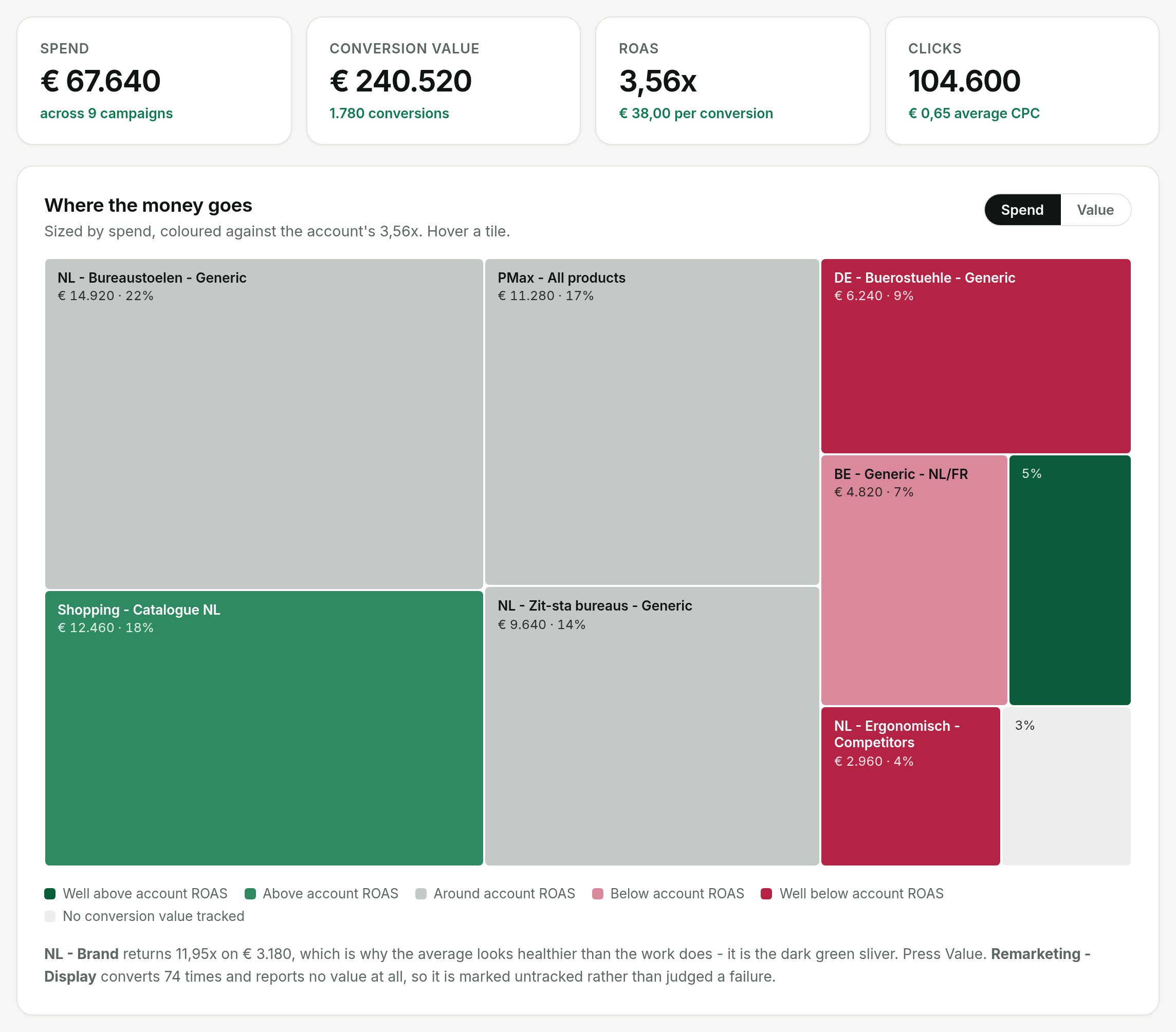
GoodLads starts from the connection. It reads the last 30 days of every campaign in the account through the Google Ads API, researches the company behind the account, and writes three recommendations per campaign. Each one names the signal it found in your data, the change it proposes and the metric move it predicts.
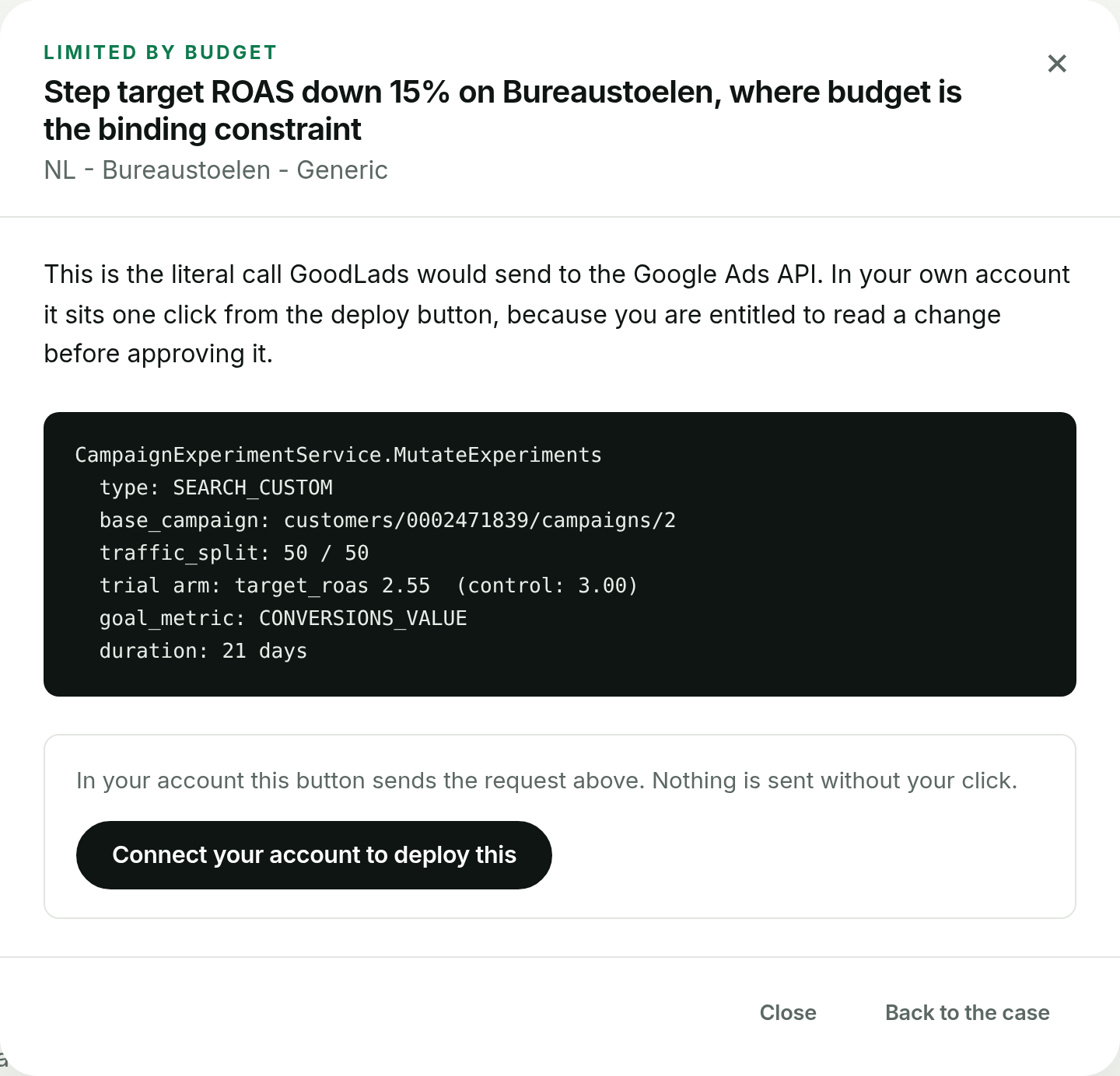
The bigger difference is what happens after the idea. Applying one is a click: a Google Ads experiment where the campaign can run one, a new paused ad where it cannot, and a live change only for the few levers with no test form, such as a negative keyword. Those live buttons are orange and ask for a second confirm. The applied change then sits on a board until there is a verdict on ROAS or CPA, and that outcome shapes the next round. A chat assistant forgets the change the moment the conversation ends.
The two also combine. Every GoodLads plan includes a read-only MCP endpoint: point ChatGPT, Claude, Claude Code or Codex at it, approve access once, and your assistant can read your campaigns, keywords and search terms from the live account. It gets the same per-lever playbooks GoodLads holds its own ideas to, so it pulls the right evidence before it looks at a figure. It can put what it finds on your GoodLads board as a proposal. It cannot change a campaign, an ad, a budget or a keyword: the server has no tool that writes to Google Ads, and deploying anything is still your click inside GoodLads.
Where ChatGPT is strong
For a lot of daily work, a general assistant is the fastest tool you have.
- Drafting: headlines, descriptions, sitelinks and landing page copy in seconds, in any language, in as many variations as you want to read.
- Flexibility: it will analyse a Microsoft Advertising export, a Meta report and a CRM file in the same conversation, which no Google-only tool does.
- Code: Google Ads scripts, GAQL, Looker Studio calculated fields and spreadsheet formulas, written and debugged on request.
- Cost: the free tiers go a long way, and a paid seat costs less than most Google Ads tools.
- Explanation: a good way to get a second opinion on a setting or to brief a new team member on why a campaign is built the way it is.
Where ChatGPT asks for trade-offs
The limits all come from the same place: the assistant sees a snapshot, has no stake in what happens next, and has no hands in the account.
- No live connection by default. Unless someone sets up a connector, every analysis starts with an export, and a stale or partial export produces a confident answer to the wrong question.
- Invented figures. Asked about numbers it has not computed from a file, a general assistant will produce plausible ones. A CPA that is off by EUR 8 on a campaign spending EUR 40,000 a month is an expensive mistake to act on.
- No memory of outcomes. It does not know that the last round of headlines lost to the control, or that the budget you raised in June pushed CPA up, unless you tell it.
- Advice without the account's constraints. Suggestions such as 'edit the ad to add the offer' or 'raise the target by 40%' ignore what an edit does to a live ad's history or what a large target change does to a Smart Bidding campaign.
- No safe way to apply. You carry the output into Google Ads by hand, or a connector with write access carries it for you, and either way the change goes live the moment it saves, with no experiment and no recorded way back unless you build one.
Where GoodLads is the weaker choice
GoodLads does fewer things than a general assistant, on purpose, and that has costs.
- It covers Google Ads only. For Microsoft Advertising, Meta or LinkedIn, a general assistant is more useful.
- It writes three recommendations per campaign. If you want forty headline variants to pick from, or a one-off analysis GoodLads has no playbook for, ChatGPT is quicker.
- It costs more than a chat subscription, and the free tier is the audit only.
- It does not write scripts, build reports in your format or answer questions outside the account.
Pricing, compared
ChatGPT and Claude each have a free tier and paid individual and team plans billed per seat. Plans and limits change often, so check their sites for current figures.
GoodLads Pro is $100 a month for one Google Ads account, whatever it spends, with a 14-day free trial. Agency is $1,000 a month for up to 10 accounts, and Enterprise is $2,000 a month with no account cap and calls with the founders. The free audit needs no subscription. The MCP endpoint is included on every plan, and your assistant runs on your own subscription and tokens, so there is no usage bill from GoodLads for it.
Which should you choose?
ChatGPT on its own is likely enough if
- You spend a few thousand euros a month and review the account yourself once a week.
- Most of what you need is drafting copy and analysing exports you already pull.
- You work across several ad platforms and want one assistant for all of them.
- You are comfortable checking every figure it gives you against the source.
GoodLads is likely the better fit if
- You spend EUR 10K to EUR 250K a month on Google Ads and a wrong change costs real money.
- You want each change applied as an experiment or a paused ad, and tracked until you know whether it worked.
- You want recommendations computed from the live account, not from an export someone pulled last week.
- You already use ChatGPT or Claude and want it reading your live Google Ads data through the MCP endpoint.
The bottom line
ChatGPT is a drafting and analysis partner, and a good one. On its own it does not watch your account, does not remember what your changes did, and does not put a change into Google Ads with a test around it. For an account spending five figures a month, those three gaps are where the money goes.
GoodLads covers them: live data, a record of every applied change to a verdict, and one-click deployment that prefers an experiment over a live edit. Most teams will keep both, and the MCP endpoint lets the assistant you already use read the same live account GoodLads does.