Tool alternatives
Opteo alternatives for Google Ads: who each one fits
Reviewed September 2026 · All guides
The main Opteo alternatives are Optmyzr (deeper rules, bulk tools and five ad platforms), Adalysis (automated audits and statistical RSA testing across Google and Microsoft), GoodLads (three business-grounded hypotheses per campaign, applied as experiments), WordStream's free tools or Adzooma for small accounts, Google Ads scripts, and an agency. The right one depends on why you are leaving. If you need more depth or more channels, move up to Optmyzr or Adalysis. If you want fewer live edits and more tested changes, look at GoodLads. If the account is small and price is the issue, Adzooma or Google's free tools cover the basics.
Opteo is a well-liked product with a short learning curve, and for a lot of Google-only managers it is the right tool. This guide is for the cases where it has stopped fitting.
Why people look for an Opteo alternative
Opteo does what it promises: it monitors a Google Ads account, surfaces 40+ types of statistically backed Improvements, and applies each one in a click. The reasons people look elsewhere are specific.
- They need more depth. Opteo is built around its Improvements feed, with no full rule engine, bulk editor or root-cause diagnostics to match Optmyzr's, and power users hit that ceiling.
- They run other channels. Opteo is Google Ads only; a team that also manages Microsoft Ads or Meta needs a second tool anyway.
- The price grows with the book. Opteo is tiered by account count and total spend, entry reported at around USD 129 a month as of 2026, so an agency adding clients moves up tiers.
- The suggestions lack context. Reviewers report Improvements that contradict each other or ignore what the business sells, so someone still has to filter them.
- They want fewer live edits. Accepting an Improvement writes straight to the campaign: bids, budgets, schedules, pausing. Teams on large budgets sometimes prefer to test a change before it touches the full campaign.
Which of these is yours decides the shortlist. The first two push toward bigger suites. The third and fourth can go either way. The fifth points toward experiment-first tools or Google's own Experiments feature.
What to check before you switch
- Open Opteo's history of accepted Improvements for the last 90 days and group them by type: bids, budgets, negatives, pausing, ad copy, schedules.
- Mark the groups that ran weekly. Those are the jobs the replacement, or a person, has to take over on day one.
- Check the Google Ads change history for the same period to confirm what Opteo wrote, so nothing is running that you did not know about.
- List any alerts or budget monitoring you rely on. If the new tool does not cover them, rebuild them as Google Ads automated rules or a script before you cancel.
- Record a 30-day baseline per campaign (spend, conversions, CPA or ROAS) so you can judge the switch on numbers.
Avoid running two tools that both apply bid or budget changes to the same campaign. Pick one to write and let the other only read during any overlap.
The shortlist, and who each one fits
Optmyzr: more depth and more channels
Optmyzr is the step up. It offers 80+ tools, a Rule Engine that can edit live entities or run on a schedule, bulk management, and diagnostics that reviewers praise for finding the cause of a drop quickly. It covers Google, Microsoft, Amazon, Meta and LinkedIn Ads. The trade is a steeper learning curve and a higher price, tiered by spend, with the entry tier reported at around USD 249 a month as of 2026. It fits agencies and PPC specialists who work inside the tool all day. Full comparison: GoodLads vs Optmyzr.
Adalysis: audits and statistical ad testing
Adalysis runs automated checks across the whole account every day and tests responsive search ads continuously, flagging significant winners and losers. It covers Google and Microsoft Ads and includes unlimited accounts and users on a spend-tiered plan, which makes it attractive for agencies. It is more rigorous on ad testing than Opteo, and less polished: reviewers call the interface dated, and more of the execution falls to you. Full comparison: GoodLads vs Adalysis.
GoodLads: fewer changes, tested first
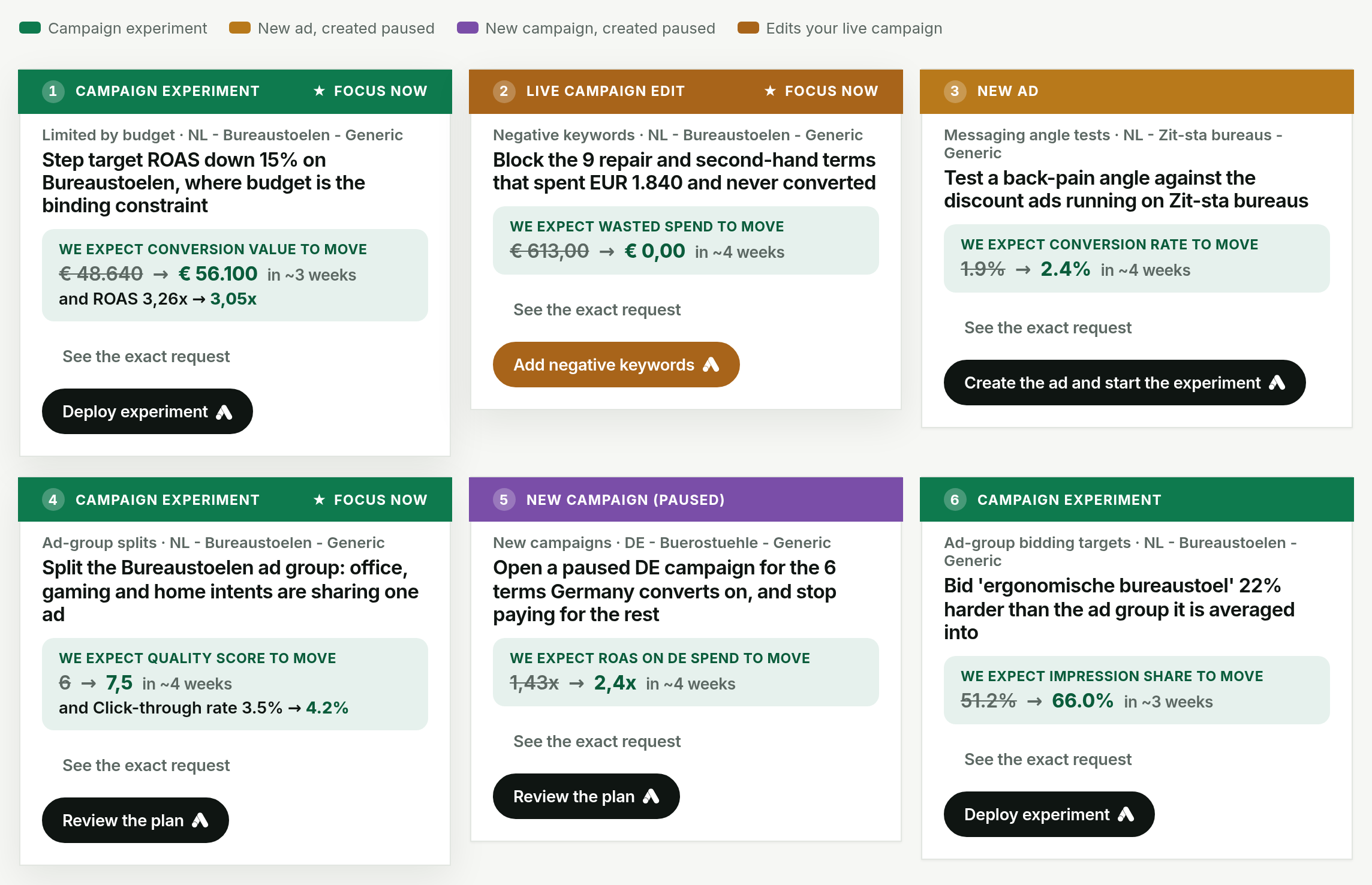
GoodLads writes three hypotheses per campaign from the last 30 days of data and research on the company behind the account, each aimed at ROAS or CPA. Applying one creates a Google Ads experiment where the campaign supports it, or a new paused ad where it does not; the few levers with no safer form, such as a negative keyword, apply live behind an orange button and a second confirm. A board follows each change to a verdict. It is Google Ads only, it does not adjust bids, budgets or schedules across the account the way Opteo does, and it is the younger product. It fits a team on a few sizeable accounts that wants tested changes in place of a stream of small live edits. Full comparison: GoodLads vs Opteo.
WordStream or Adzooma: for small accounts
If the account spends a few thousand euros a month and Opteo's price is the problem, go cheaper. Adzooma has a free tier and flat paid plans, with one-click Opportunities across Google, Microsoft and Meta, and reviewers note that many of its suggestions overlap with Google's own. WordStream's free Google Ads Performance Grader gives a one-off health check; its paid offering today is mostly LocaliQ's managed service. Both suit small businesses and freelancers. Above roughly EUR 10,000 a month, the depth usually runs out.
Google Ads scripts and Google's own tools
Most of what Opteo automates can be rebuilt with free Google tools: the Recommendations page for suggestions, Experiments under Campaigns for tests, automated rules for pausing and budget changes, and Google Ads scripts for alerts, pacing and custom logic. It costs nothing but time, and someone has to write, test and maintain each script. A script that misfires writes to the live account with nobody watching. More on that trade: GoodLads vs Google Ads scripts.
An agency
If nobody in the company has the hours to review Improvements every week, another tool will not change that. An agency supplies the people, and usually strategy, ad creative and landing page work on top. Retainers are commonly a percentage of spend or a flat fee, so on a EUR 30,000 a month account the cost runs to thousands of euros a month, against a tool subscription in the hundreds. Full comparison: GoodLads vs a PPC agency.
Pick by the reason you are leaving
- Hit the ceiling on rules and bulk work, or need other ad platforms: Optmyzr.
- Want rigorous RSA testing and daily audits, including Microsoft Ads: Adalysis.
- Want fewer, business-grounded changes tested before they go live: GoodLads.
- Small account and price is the issue: Adzooma or WordStream's free tools.
- Have a technical PPC lead and a short list of automations: Google Ads scripts.
- Have no one with time to run the account: an agency.
If none of those match, stay. Opteo remains one of the easiest tools in the category to learn, and switching costs a few weeks of attention whatever you move to.
Where GoodLads fits
GoodLads overlaps with the part of Opteo that tells you what to change and applies it in a click. It differs on what apply does: it defaults to a Google Ads experiment or a new paused ad over editing a live campaign, and nothing reaches Google Ads without your click on a specific card. It does not replace Opteo's routine maintenance or budget control; if those are what you use Opteo for, keep them somewhere.
The free audit reads one account and returns what it is doing and the three things worth doing about it. Pro and Agency start with a 14-day free trial, and every plan includes a read-only MCP endpoint for pointing Claude or ChatGPT at your own account data.
Questions people ask
What is the best alternative to Opteo?
For more depth and more channels, Optmyzr. For rigorous ad testing and daily audits across Google and Microsoft, Adalysis. For a few tested, business-grounded changes per campaign, GoodLads.
Is there a free alternative to Opteo?
Google's own Recommendations page, Experiments, automated rules and Google Ads scripts are free, and Adzooma has a free tier. They cost time instead of money, and the free tools give less context on why a change is suggested.
Is Opteo or Optmyzr better?
Opteo is easier to learn and cheaper to start, and covers Google Ads only. Optmyzr is deeper, covers five ad platforms and suits power users who spend the day inside it.
Does Opteo make live changes to my campaigns?
Yes. When you accept an Improvement, Opteo writes the change directly to the account, including bids, budgets, schedules and pausing. Improvements are applied when you accept them.