AI and automation
Using AI to manage Google Ads: what to automate and what to keep
Reviewed September 2026 · All guides
Automate the tasks where a mistake costs time, and keep a person on the tasks where a mistake costs budget. In practice that means handing AI the reading and reporting, the first drafts of ad copy and the search for opportunities, while every change to a serving campaign goes through a human approval that shows the exact change. Bidding inside a campaign is the exception: Smart Bidding sets a bid per auction from signals no person can weigh at that speed, provided you control the target and the conversion data it bids toward.
Accounts spending EUR 10,000 to EUR 250,000 a month now run on three layers of AI at once: Google's automation inside the platform, third-party tools on top, and general assistants such as ChatGPT and Claude on the side. Each layer is good at different things and fails in different ways. This guide sorts them, then splits the work by risk.
Google's own automation
Google Ads is already an AI system with a settings page. Four parts of it matter most for this decision.
Smart Bidding
Target CPA, Target ROAS, Maximize conversions and Maximize conversion value set a bid for each auction from signals no manual bid can use: device, location, time, audience, query and more. Once a campaign has enough conversion data, that per-auction bidding is hard for manual CPC to match. What it cannot do is decide what a conversion is worth, which target the business can afford, or whether the conversion data is clean. Those stay with you, and they are covered in Target CPA vs Target ROAS and the conversion tracking checklist.
Performance Max
Performance Max hands Google targeting, placement and asset combination across Search, Shopping, YouTube, Display, Discover, Gmail and Maps. You keep the inputs: assets, audience signals, the feed, the goal and the budget, plus brand exclusions and, since 2025, campaign-level negative keywords, a search terms report and channel performance reporting. It is the clearest case of automating execution and keeping strategy.
AI Max for Search campaigns
AI Max for Search campaigns brings part of that model to Search: a campaign-level setting, launched in 2025, that matches queries beyond your keywords, customizes ad text and can send traffic to other pages on your site. It changes which queries a campaign serves on, so treat switching it on like a match-type change and test it in an experiment where you can.
Auto-apply recommendations
Auto-apply lets Google apply its own recommendations without review: broad match keywords, keyword removals, bid strategy switches and target changes, assets. It does not raise budgets. This is the one piece of Google's automation that changes spend decisions without a person in the loop, and on a large account most of its types belong off. The detail is in Should you turn off auto-apply recommendations?.
Third-party tools
Tools such as Optmyzr, Opteo and Adalysis sit on top of the Google Ads API. They monitor accounts, flag problems, run rule-based automations and let you apply changes from their own interface. The good ones show the data behind each suggestion. The questions to ask about any of them are the same:
- Does it write to the account on a schedule without a click, or only when you approve a change?
- When it applies a change, does it edit the live campaign, or can it create an experiment or a new paused ad instead?
- Can you see and reverse what it applied, with a date and an author in Google Ads change history?
- Does it know anything about the business behind the account, or only the account data?
General assistants: ChatGPT and Claude
ChatGPT and Claude are strong at the language half of the job: summarising a report, drafting headlines, explaining a metric to a client, turning a search terms export into themes. They are weak where they lack your account's context and a method for reading it. Paste in a CSV and ask what to do, and you get a fluent answer built on whichever columns you exported, with no memory of what was tried last quarter.
Connecting the assistant to live account data through MCP closes the data gap: it can pull search terms, campaign spend and Quality Score itself. Google Ads MCP covers the ways to do that and why the connection should be read-only. The method gap remains unless the server brings one. For how a general assistant compares with a dedicated Google Ads tool, see GoodLads vs ChatGPT.
Splitting the work by risk
Sort every task by what a mistake costs. Four rungs cover almost everything in a Google Ads account.
1. Reading and reporting: automate
Pulling figures, comparing periods, spotting anomalies, writing the weekly client summary. A mistake here costs a wrong sentence that a person reading it can catch. Hand this to AI with read-only access and check the figures it quotes against the interface for the first few weeks.
2. Drafting copy: automate the draft, keep the edit
Headlines and descriptions for a responsive search ad, sitelink text, variants for a test. Assistants produce useful drafts quickly. A person checks every claim, price and regulated statement before it goes anywhere, because a generated headline can promise something the business does not offer. Then test the new copy against the old in an experiment before it replaces anything.
3. Proposing changes: automate the search, keep the decision
Finding the campaign where CPA drifted, the search terms that spend without converting, the budget that is capped while its CPA is below target. AI is good at searching an account for these and writing each one up with the evidence. Say an assistant flags a campaign spending EUR 12,000 a month at a EUR 95 CPA against an account average of EUR 60. That is a finding. Whether to lower the target, restructure the campaign or accept the CPA because those leads close better is a decision about the business.
4. Applying changes to live spend: keep, with one-click approval
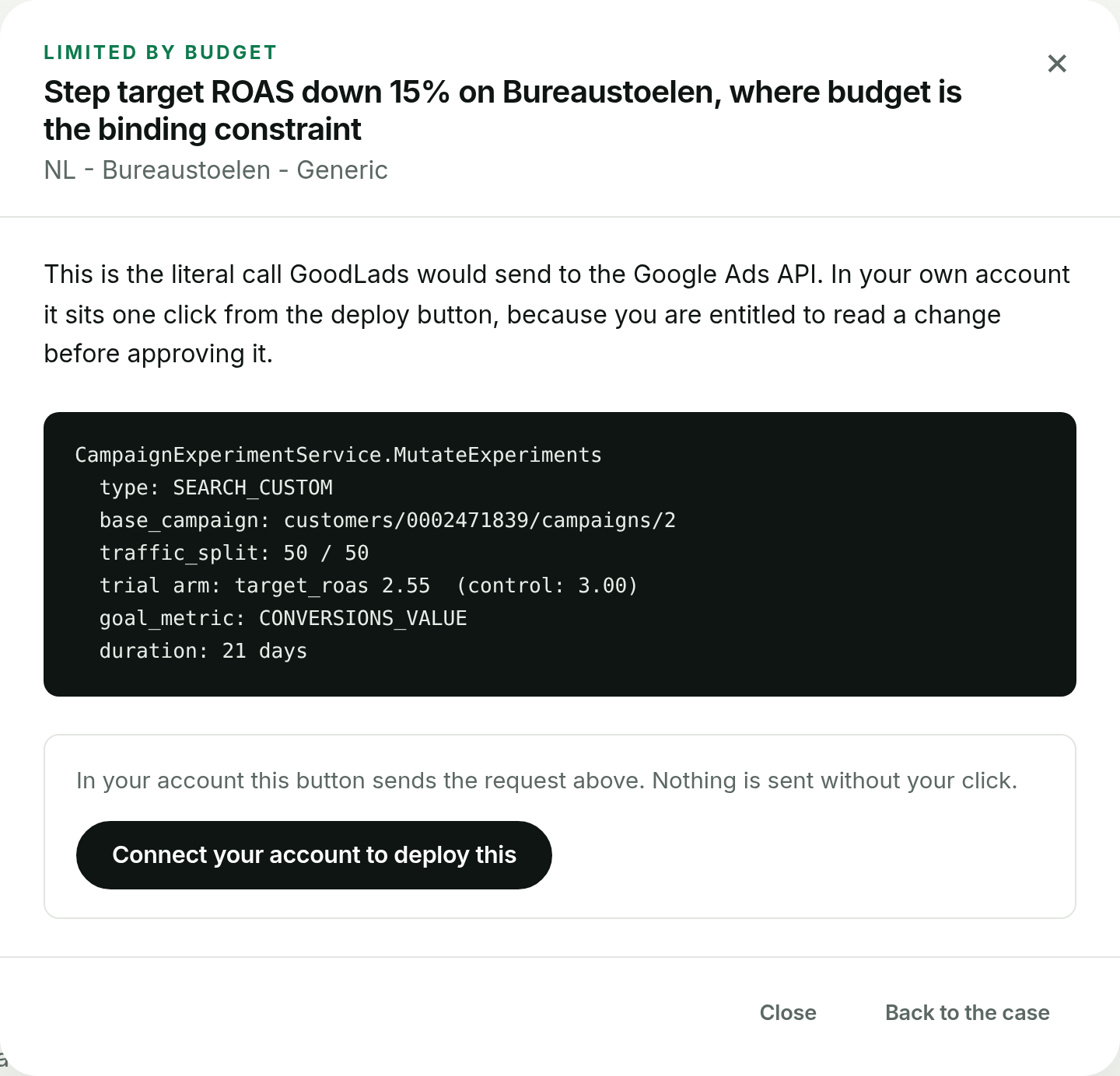
Budgets, bid targets, match types, negative keywords, pausing and enabling. A mistake here spends money before anyone notices. The work of preparing the change can be automated; the application should wait for a person to approve that specific change, seeing what it will do. Where the lever allows it, apply it as a Google Ads experiment or a new paused ad so the running campaign keeps serving while the change is measured.
The approval principle
One rule covers all four rungs: no change that affects how a serving campaign spends applies without a person approving that change. Approval here means seeing the exact change (this campaign, this budget, from EUR 400 to EUR 480 a day) and clicking once. A weekly "approve all" on a list of forty changes fails the test, and so does a rule that fires on its own at 3am.
The rule does not slow things down much. Preparing a change is where the hours go, and AI can do that part. Approving a prepared change takes seconds. What the rule buys is a named person for each change to live spend, a date in the change history, and a moment where someone asks whether this is the right week to do it.
Two refinements follow from it. Prefer the reversible form of a change: an experiment can be ended, a paused ad can stay paused, a live edit to a serving ad mixes old and new copy in one history, so its effect cannot be read cleanly. And record the outcome of each applied change, so the next round of proposals starts from what worked in this account instead of general advice.
Where GoodLads fits
GoodLads works on rungs three and four. It reads the account and researches the company behind it, writes three recommendations per campaign with the figure behind each, and applies one only when you click. It prefers a Google Ads experiment or a new paused ad; the few levers that have to write to the live campaign, such as negative keywords, are marked in orange with a second confirm. Every applied change is tracked on a board to a verdict. It covers Google Ads only, and it does not tune bids or budgets across every campaign on a schedule. Its read-only MCP endpoint lets Claude or ChatGPT read the same data for rung one.
Questions people ask
Can AI manage Google Ads on its own?
Google's Smart Bidding and Performance Max already automate bidding and placement inside campaigns. Budgets, targets, conversion definitions and changes to live spend still need a person to approve them, because a mistake there spends money before anyone sees it.
Can ChatGPT manage my Google Ads account?
ChatGPT can read and analyse account data, especially when connected through a read-only MCP server, and it drafts ad copy well. It lacks your account history and business context unless you supply them, so treat its output as proposals to review.
What Google Ads tasks should I automate with AI?
Reporting, anomaly spotting, search terms analysis and first drafts of ad copy. Keep the decision and the approval on budgets, bid targets, match types and anything else that changes live spend.
Is Smart Bidding better than manual bidding?
For most accounts with enough conversion data, yes, because it bids per auction on signals manual bids cannot use. It depends on clean conversion tracking and a target you set deliberately.