Testing and experiments
How to A/B test responsive search ad copy
Reviewed September 2026 · All guides
To A/B test responsive search ad copy, change one message, put it in a separate ad or an experiment arm, and compare the two versions on conversions per impression over at least two to four weeks. For a controlled test with a split and a confidence interval, use ad variations or a custom experiment under Campaigns > Experiments. For a quicker read, add a second RSA with the new message to the same ad group next to the existing one, and accept that Google, not a coin flip, decides how impressions are shared. Ad strength and the per-asset statistics are not test results; do not use them to pick a winner.
The hard part of testing RSAs is that one ad serves many combinations of up to 15 headlines and 4 descriptions. A test has to isolate a message across all of those combinations, and reporting will only partly show you which message did the work.
Ad strength is not a performance metric
Ad strength rates an RSA from Poor to Excellent on how many assets it has, how different they are from each other, and whether they include your keywords. It is a checklist for giving Google enough material to combine. Google states that ad strength itself does not feed into the auction.
An Excellent ad can convert worse than an Average one, because the things ad strength rewards (more headlines, more keyword inclusion, less pinning) are not the things that make a specific buyer act. Use ad strength to catch an ad with three near-identical headlines. Do not use it to choose between two ads, and do not strip out pins or add filler headlines to raise it.
What asset-level reporting can and cannot tell you
In the asset report for an RSA you can see each headline and description with full statistics: impressions, clicks, cost, conversions and conversion value. Google added these in 2025, for dates from 5 June 2025 onward, and deprecated the old Performance label column (Low, Good, Best) in their place. The combinations report shows which headline and description sets served. Both are useful for spotting a headline that never serves or one that dominates.
Its limits matter for testing:
- Serving is not random. Google shows each asset where it predicts it will do well, so an asset's conversion rate reflects the queries and users it was matched to as much as its text.
- Assets are never seen alone. A headline's numbers include every combination it appeared in, with whichever other headlines and descriptions it was paired with.
- Low-impression assets have no usable data. Google serves an asset it predicts will do poorly less often, so it never gets a fair sample.
- The combinations report shows impressions, not conversions, so it tells you what served, not what won.
Asset reports are good for generating hypotheses ("price-led headlines get most of the impressions"). They are poor at confirming them. Confirm with one of the methods below.
Three ways to test RSA copy
1. A new ad alongside the old
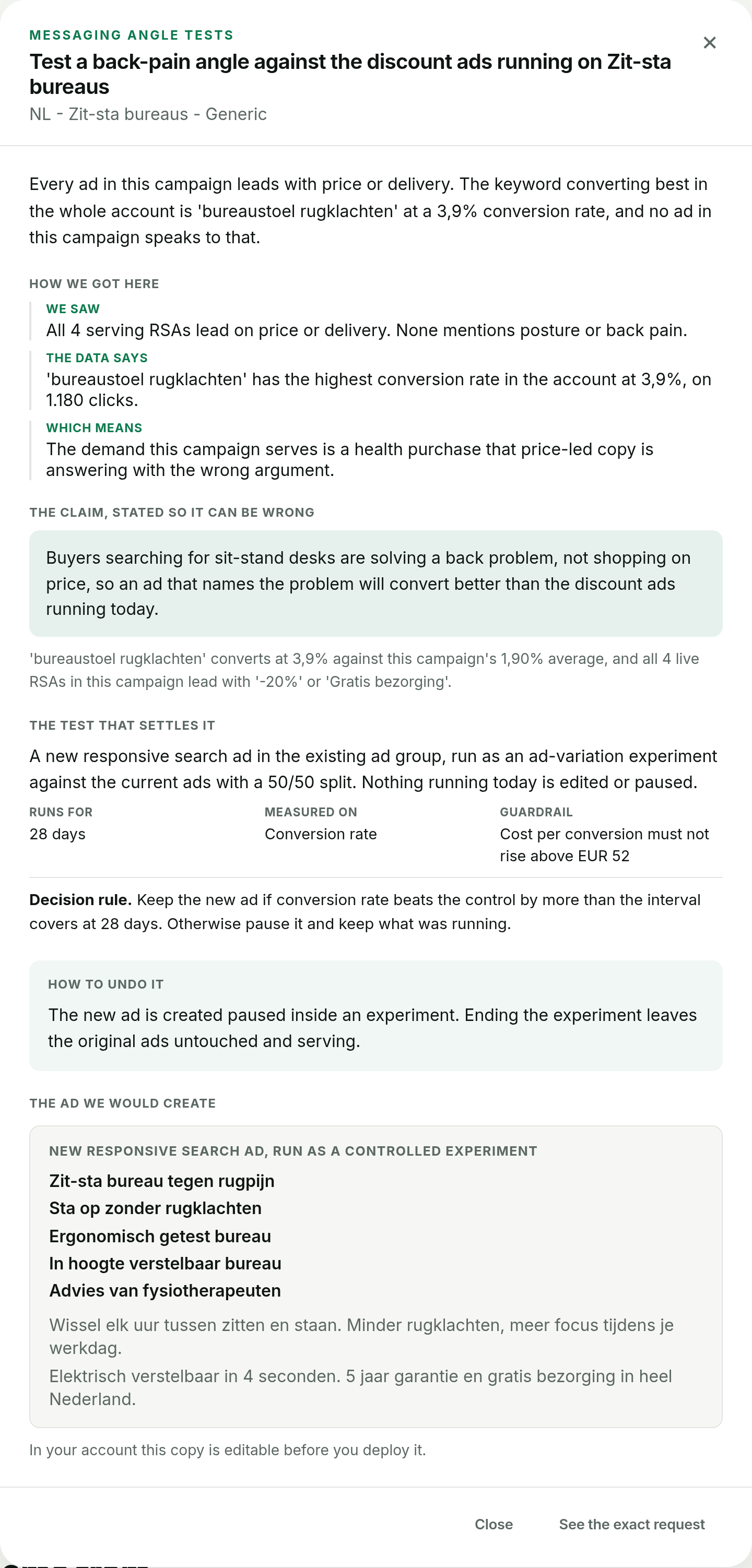
Create a second RSA in the same ad group with the new message, keep the existing ad running, and compare the two after a few weeks. An ad group can hold up to three enabled RSAs. This is quick, needs no experiment setup, and leaves the proven ad and its history intact, which matters because editing a live ad mixes old and new copy in one history.
The trade-off: Google chooses which ad to show in each auction and favours the one it expects to perform, so the split will be uneven and the comparison is observational. Treat a large, sustained gap as a result and a small one as noise.
2. Ad variations
Under Campaigns > Experiments, ad variations apply a text change across many ads at once: find and replace a phrase, update a headline or description, or swap in new text. You choose the campaigns, the change and the split, Google splits by cookie so each user sees one version, and it reports the variation against the originals with a confidence interval. It is the fastest route to a controlled copy test across a whole account, such as "Free delivery" against "Delivery in 24 hours" in every ad that mentions shipping.
3. A custom experiment
A custom experiment copies the whole campaign into a trial arm where you can replace the ads entirely: a new angle, a new structure, new landing pages to match. Use cookie-based splitting for copy tests where the same buyer searches several times before converting, so each person sees one version consistently. This is the most work to set up and gives the cleanest answer.
Designing a copy test that can find something
- Pick one message to test: an offer, a proof point, a price anchor, an objection handled. Write it down as a hypothesis with the metric you expect it to move.
- Express that message in three or four headlines, so it appears in most combinations the ad serves. A single new headline among fifteen may barely serve.
- Pin where you need to force exposure. Pinning a headline to position 1 guarantees every impression carries the message. Pinning reduces the combinations Google can try and lowers ad strength; for a test that is the point, because you want the message seen.
- Keep everything else equal between arms: same other assets, same final URL unless the landing page is part of the test, same pins apart from the one you are testing.
- Run whole weeks, at least two to four depending on volume. How long an experiment should run has the arithmetic.
- Read the result on the metric you chose, after the first week, and log it either way.
What to measure: conversions per impression
CTR is the metric copy tests are most often judged on, and it misleads. An ad that promises something the landing page does not deliver raises CTR and lowers conversion rate. Conversion rate alone misleads the other way: an ad that repels most clicks can convert the few it keeps.
Conversions per impression (conversions divided by impressions, or CTR multiplied by conversion rate) captures both. It asks which ad produces more customers from the same number of times it was shown. Add it as a custom column in the Ads view. Where cost per click differs between arms, check CPA as well, and for e-commerce use conversion value per impression and ROAS.
Say two RSAs each get 100,000 impressions over four weeks. Ad A has a 6% CTR and a 3% conversion rate: 6,000 clicks, 180 conversions. Ad B has a 4.5% CTR and a 4.5% conversion rate: 4,500 clicks, about 202 conversions. Ad B loses on CTR by a quarter and wins on conversions by about 12%. At a EUR 1.20 CPC, B's CPA is about EUR 26.70 against A's EUR 40.
Where GoodLads fits
GoodLads writes new ad copy from your account data and research on the company behind it, and adds it as a new ad created paused next to your existing ads, or as a trial arm in a Google Ads experiment where the campaign supports one. On Performance Max it tests headlines and descriptions through an asset experiment. Each applied idea is tracked on a board to a verdict, and you can see how that looks in the demo.
It does not run ad variations across your account, and it does not rotate or pause your ads on a schedule. If you manage copy testing at scale across many accounts, compare it with Adalysis, which is built around ad testing.
Questions people ask
Does ad strength affect Google Ads performance?
Not directly. Ad strength rates how many varied assets an RSA has; Google says it is not an auction input, and an ad rated Excellent can convert worse than one rated Average.
How do I A/B test responsive search ads?
Use ad variations or a custom experiment under Campaigns > Experiments for a split with a confidence interval, or add a second RSA to the ad group for a quicker observational comparison.
Should I pin headlines in responsive search ads?
Pin when a message must appear, such as a legal line or the headline you are testing. Pinning lowers ad strength and limits combinations, which is acceptable when you need the message seen.
What metric should I use to compare ad copy?
Conversions per impression, which combines CTR and conversion rate, plus CPA or ROAS when click costs differ. CTR alone favours ads that attract clicks that do not convert.
How many responsive search ads can I have per ad group?
Up to three enabled responsive search ads per ad group.